
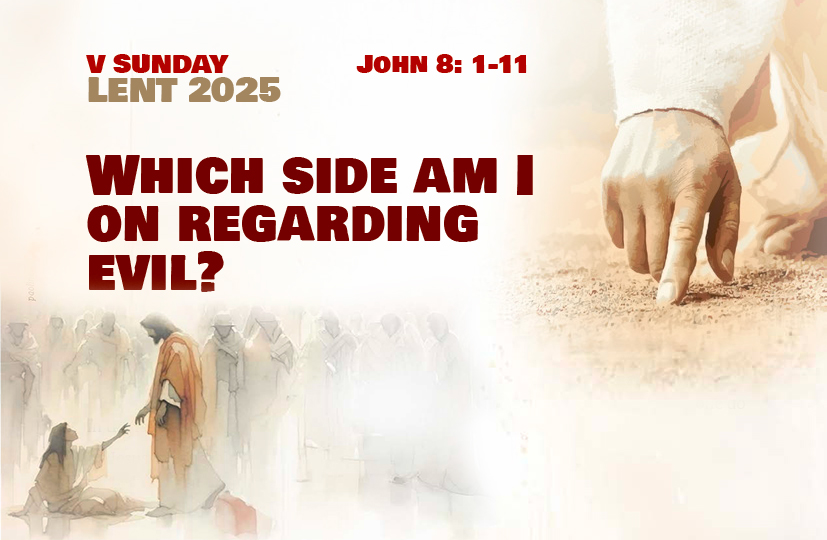




When a woman caught in adultery is brought before Jesus, the undeniable evidence of her wrongdoing is placed before His eyes. A woman with no defense. What should one do in the face of the embodiment of error?
Jesus says nothing. He writes on the ground, stretching time. The first thing one realizes when reading this passage is Jesus’ authority. He does not allow Himself to be swept away by events. He feels no urgency to set things right immediately, nor does He fear the world, evil, judgment, or even error. Jesus fears nothing. He takes His time, refusing to be crushed by circumstances. His heart is anchored Elsewhere.
He absorbs the violence around Him and does something remarkable—something that changes one’s perspective forever: He redirects the gaze of the crowd. He shifts responsibility. He asks those present to step forward and expose themselves. His response is not a direct resolution; it does not immediately defeat violence. But it initiates a change of perspective, a crucial first step: responsibility. Who among you is without sin? Which is to say: Where do you stand in relation to error?
Are you on the side of those who cast stones? Do you think that by throwing them, you can bury sin? Are you among those who always believe they know where truth stands?
Jesus does not ask collectively but personally. Instead of addressing a faceless crowd, He says “whoever”—pulling individuals out of the anonymity of the mob. In the crowd, my stone is mixed with many others. But that is a coward’s game.
The real question, the one that still shakes us today, is: “Where do I stand in relation to evil?”
